I’ll be honest with you: my hope had been eroding.
For the past six months I’ve been having weekly conversations about AI — coffee chats, community meetups, informal gatherings with curious and concerned people. I’m the one who usually walks in with the briefing, the research, the evidence. But lately, walking in has required a deliberate effort to hold the fear back. The pace of AI development is accelerating in ways that genuinely frighten me. Not in a vague, science-fiction way. In the specific way that comes from reading the primary sources, understanding what they mean, and knowing that most people around you don’t yet see it.
Then I read Pope Leo XIV’s encyclical on artificial intelligence. And something shifted.
Not because the news was good — it isn’t. Not because the Pope has solutions — he doesn’t, not fully. But because of what his decision to write this document means, and because of the quality of thinking inside it.
An encyclical is not a blog post
Pope Leo XIV published Magnifica Humanitas — “The Magnificent Humanity” — in May 2026. It is the first papal encyclical ever dedicated to artificial intelligence.
For those unfamiliar: an encyclical is the highest form of formal teaching in the Catholic Church. It is addressed, in this case, to 1.4 billion Catholics. It is a considered, deliberate act — not a reaction, not a press release, not a comment on the news cycle. A Pope does not publish an encyclical lightly.
The last time a Pope used this format to address technology and labour was 1891. That document — Rerum Novarum — responded to the disruptions of the first Industrial Revolution. It took decades for the labour rights and collective bargaining frameworks it helped inspire to become law. But it provided the ethical vocabulary that eventually shaped how societies addressed industrial capitalism’s costs.
Pope Leo XIV draws this parallel explicitly. We are, he argues, in the same position now — after enough has happened to understand what’s coming, but before the frameworks to address it have solidified. Magnifica Humanitas is an attempt to provide those frameworks early enough to matter.
That framing is what gave me hope. Not the encyclical’s conclusions, but its timing — and what the timing says about where we are.
What the encyclical actually says
I want to share three ideas from the document I keep returning to, because they are more practically useful than most of what I’ve read from technology commentators.
AI systems are cultivated, not built. The encyclical describes how developers don’t directly design every detail of an AI system — they create a framework within which the intelligence “grows.” As a result, even the people who build these systems don’t fully know what they’ve made. This reframes a common regulatory instinct — just be transparent, show us the code — as insufficient. There is no code that explains the behaviour, because the behaviour emerges from conditions, not deliberate design. Someone who doesn’t understand this will design the wrong safeguards.
Algorithmic systems cannot extend mercy. Important decisions — employment, credit, access to public services — are increasingly being delegated to automated systems. The encyclical names what those systems lack: “compassion, mercy, forgiveness, and above all, the hope that people are able to change.” A person’s past becomes permanent in ways no human judge would allow. This is not a bug to be fixed. It is a structural feature of systems that optimise for consistency. Human judgment must remain in the loop wherever context and the possibility of redemption are relevant.
Data is a collective product. The encyclical argues that “ownership of data cannot be left solely in private hands.” Your online behaviour, your health records, your purchasing patterns — these are individually yours, but they gain value and meaning in aggregate. The collective production of data entails collective claims on it. This is a direct challenge to the foundational business model of every major AI company — not an abstract philosophical point, but a practical one about governance and rights.
The Pope is not alone
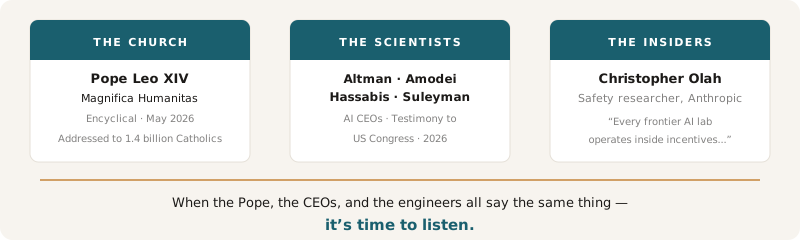
What gives the encyclical its particular weight, in this context, is that the same message is arriving from completely different directions.
The CEOs of the largest AI companies — Altman, Amodei, Hassabis, Suleyman — testified to the US Congress that AI systems now outperform PhD-level virologists, and that the knowledge barriers which have historically protected against the creation of biological weapons are meaningfully eroding.
From inside one of those companies, a safety researcher has said publicly: “Every frontier AI lab operates inside incentives that can conflict with doing the right thing.”
Think about what that convergence means. The Pope speaks from a tradition of moral philosophy stretching back centuries, with no financial stake in AI outcomes. The CEOs speak from the centre of economic power, under oath to legislators. The safety researcher speaks from inside the systems being built, with technical knowledge no outsider has.
They do not agree on much. They agree on this.
The window
One of the most useful ideas in Magnifica Humanitas is what I think of as the window argument. We are in the same position relative to AI as society was in 1891 relative to industrial capitalism — after enough of the transformation is visible to understand what’s happening, but before the damage is irreversible and the frameworks are locked in.
This is not a comfortable place to stand. But it is a different one from standing after the lock-in, watching with no ability to influence outcomes.
Rerum Novarum didn’t change things immediately. It took decades. But the arguments were made, the vocabulary was established, and when societies were ready to act — when enough people demanded frameworks — the language already existed. That is what I believe Magnifica Humanitas is doing. And it is what I’m trying to do at the community level: building the vocabulary, the relationships, and the awareness before we need them.
The window is still open. That is worth something.
What I’m not saying
I’m not saying the Pope will save us. I’m not saying institutional statements are enough. I’m not saying that because serious people are paying attention, the outcomes are assured.
I am saying: when institutions this different — in purpose, audience, incentives, and tradition — converge on the same message, the convergence is itself a signal. It tells us the concerns are real, that they are visible across the full spectrum of human authority, and that we are still in a moment where the frameworks can be shaped rather than merely received.
The fear I feel about where AI is heading is real. The hope I now also hold is this: the right voices are speaking, with clarity, at the right time. What we do with that is still up to us.
That’s what these conversations are for. And it’s why I think you should be part of them.
If you’re new here, you might want to start with The Conversation We Need to Have →, or read about why community is the most important preparation →.
Join the conversation at our next monthly meetup →