Five years ago, our town in the foothills of the Snowy Mountains spent three weeks surrounded by fire.
I don’t have a heroic story from that time. Mostly what I remember is feeling frozen. A kind of persistent low-grade shock that sat beneath everything else for the entire three weeks. We evacuated twice — the manic calculation of what you pack into a station wagon when you don’t know if you’re coming back, where you’ll go, how long you’ll be gone. We were relatively safe in the middle of town. One town over wasn’t. The fire swept through it. We got lucky — and we were deeply grateful to the local bush fire teams and the volunteer firefighters who came from across half the country to stand between us and something we couldn’t have faced alone.
I remember the tent camp at the sports ground where the visiting firefighters were staying. The massive portable air-conditioning units pumping into the tents in the summer heat. The faces of the crews returning for their mandatory rest — food, sleep — before they went back out. The particular look of exhaustion that comes from doing something that matters under conditions that take everything you have.
And then the fires passed, and we started hearing the stories. People who had lost everything — house, possessions, the physical objects that hold memory. Farmers who’d saved their homes by personally fighting the flames through the night, only to find the sheds, equipment, and livestock gone. Everything but the house.
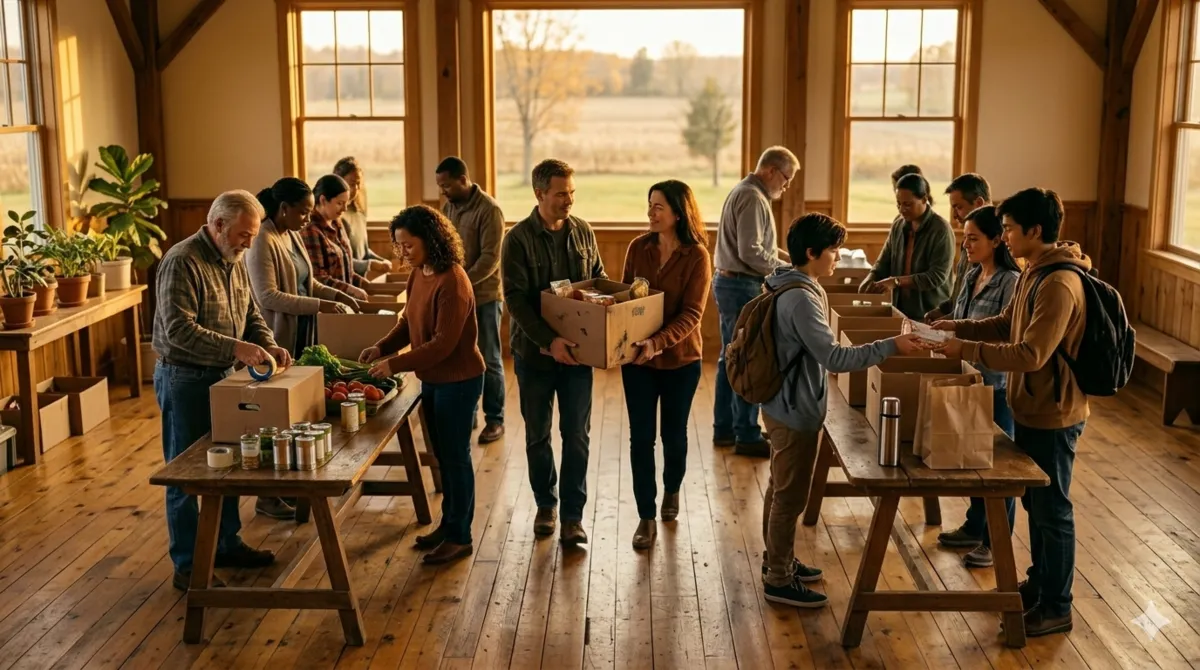
Two responses to the same crisis
During those weeks, something clarified itself for me about what community actually means — not as an abstract value, but as something operational.
A local café owner started making food every day. Box lunches, available to anyone who needed them. No charge. She did this for weeks, foregoing income she needed, because people in her community needed to eat.
In the nearby towns, some motel owners raised their prices. People evacuating in the middle of the night, with nowhere to go — and the price went up. Same crisis. Opposite responses.
The difference wasn’t character, exactly. It was relationship. The café owner knew these people. They weren’t an opportunity; they were her neighbours, her regulars, the faces she’d been seeing for years across the counter. The motel owners saw strangers, and treated them accordingly.
This is what community actually does in a crisis: it changes who counts as us. And that distinction — between neighbours and strangers — determines almost everything about how people respond when things get hard.
There were other things. Locals driving around checking on the people who chose to stay, asking what they could do. Police at the crossroads — not functioning as authority, but as caring fellow humans. After the fires: donation tins, offers of physical help to rebuild what could be rebuilt. The whole machinery of mutual support that activates when people feel connected to each other’s fate.
And then there was the thing that’s hardest to describe. In the weeks after, residents would simply look at each other — a particular recognition, wordless. We went through this together. You understand. No explanation needed. That shared experience had become part of who we were to each other.
That’s what community builds. And here’s the critical thing: it can’t be built during the crisis. It has to already exist.
The fire that isn’t visible yet
With the bushfires, there was no problem with awareness. The fire was self-evident. You could see the smoke, feel the heat, smell it. Nobody needed convincing that something serious was happening.
The disruption coming from AI is different. It’s not yet visible in the same way. For most people, life still looks approximately normal — jobs exist, routines continue, the changes feel incremental and distant. The smoke isn’t in the sky.
But for people who work closely with these technologies, who watch the research, who talk with those building these systems — the picture looks different. The pace of change is faster than most people understand. The economic disruption to knowledge work is already happening, not arriving. And the deeper questions — about what happens as AI systems become more capable, about whether we can ensure they remain aligned with human values — are questions the people closest to the work take very seriously indeed.
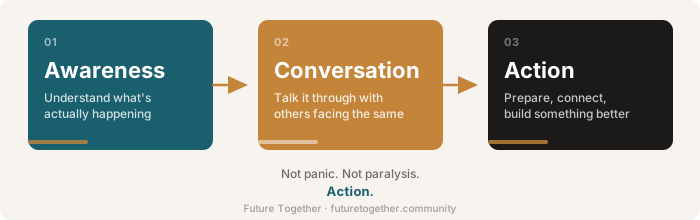
This is the gap that Future Together exists to close. Not through alarm, but through honest conversation. If communities need to be built before a crisis arrives, then awareness has to come before community. People don’t organise around threats they don’t believe are real.
I’m not the authority. I’m a witness.
I want to be clear about what I am and what I’m not in this conversation.
I work in AI. I build AI tools. I watch the technology evolve day by day, and what I’ve been witnessing has fundamentally changed how I think about the next few years. I’ve had conversations with people working inside major AI labs that have shaken me. I’ve seen the pace of change with my own eyes.
But I’m not the authority on what’s coming. Nobody is. The honest answer is that the people closest to this work carry deep uncertainty about how it unfolds, and anyone claiming certainty in either direction — collapse or utopia — is telling you more about their psychology than the actual situation.
What I can offer is: I’ve been paying attention, and I think you should too. Not because you should take my word for it, but because the evidence is available. Read about the alignment problem — why it’s so difficult to build AI that reliably does what we actually want. Understand what the singularity actually means, and why serious people think it’s the most important concept for understanding where this is going. Look at what’s happening to knowledge work right now, in concrete terms. Form your own view.
Then share what you’ve learned with the people who matter to you. Not to frighten them — but to start the conversation. Because the awareness has to spread through exactly that mechanism: one person saying to another, I’ve been looking at this, and I think we need to talk about it.
That’s how the café owner relationship gets built before the fires come.
The thing community provides that nothing else does
Individual preparation has real limits. You can get your financial house in order, develop new skills, build resilience in your own life — and all of that matters. But there are things you simply cannot do alone.
You cannot maintain your own food supply if supply chains are disrupted and you live in a city. You cannot process the psychological weight of rapid, disorienting change without people who share your reality. You cannot influence how institutions and governments respond to these changes without collective voice.
The research on communities navigating disruption is consistent: the communities that do best are the ones with strong existing connections, distributed trust, and a shared sense of mutual obligation. Not the ones that were individually best prepared. The ones that already knew each other.
That’s not a reason to skip individual preparation. It’s a reason to treat community-building as preparation — to see the conversations, the meetups, the relationships you’re building now as part of how you get ready for what’s coming.
The volunteer firefighters who came from across the country came because somewhere, at some point, someone had built the networks and the organisations that could mobilise them. That infrastructure existed before the crisis. It was there when it was needed.
We’re trying to build something like that for what’s coming. Not a response to a crisis already visible — a foundation for navigating one that’s still approaching.
The fires will become self-evident eventually. The question is who you’ll be standing next to when they do, and whether you’ve already had the conversation.
Start where you are. Learn what’s actually happening. Share it with someone you care about. And if you want to be part of the broader conversation — we meet every month.